

Discover how EATELabs has developed EHD laboratory and printing equipment that enables companies and research institutions to achieve their goals through cutting-edge solutions. Our success stories demonstrate our commitment to quality, innovation, and customer satisfaction.
Printed optical sensors towards breathing detection, DOI: 10.23919/LAWOFS62242.2024.10561233, LAWOFS 2024.
Demonstrates the optical sensors fabrication by printing the corresponding sensitive optical waveguides directly onto a flat substrate. Humidity-sensitive polymeric waveguides have been printed towards breathing sensing. The optical sensitive waveguides manufactured are compact, ensuring coupling with the input and output optical fibers. Unlike the traditional manufacturing process, any modification in the material, structure, dimensions, etc. of the sensitive optical waveguide can be carried out in a simple, low cost and extremely fast way.

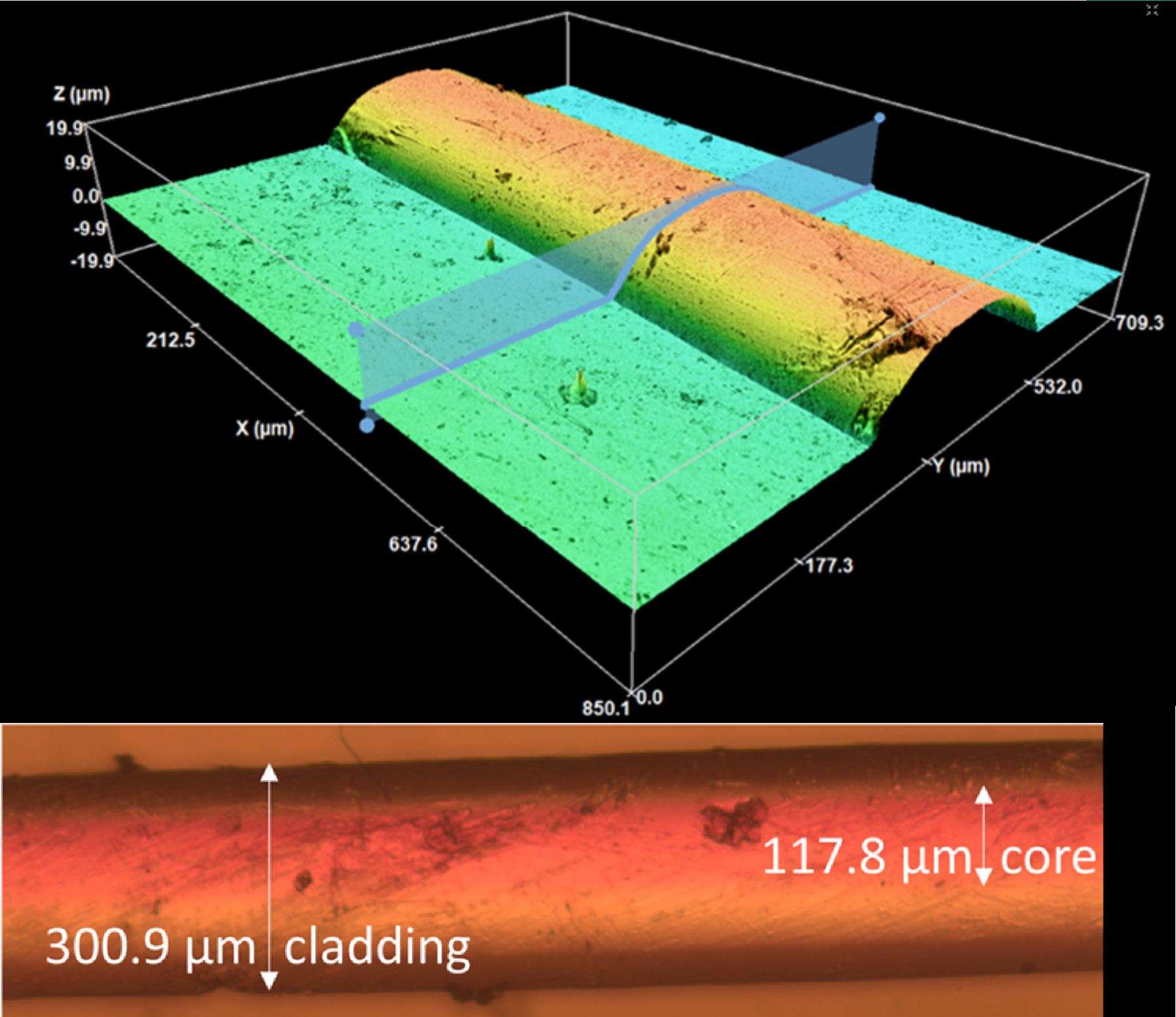
Printed Optical Waveguide Temperature Sensor with Rhodamine-Doped Core, DOI: 10.1109/LSENS.2024.3420781, 2024.
Fabrication of a temperature optical sensor by printing the sensitive optical waveguide onto a flexible flat substrate. The printed waveguide was carried out using a coaxial needle and an electrohydrodynamic (EHD) machine. The optical sensitive waveguide manufactured is compact, ensuring coupling with the input and output optical fibers. The response was evaluated to temperature variations by measurement of both, the peak intensity and the wavelength of the fluorescence spectra.
Integrated Optoelectronic Refractometer Based on ZnO Photodetector with EHD-Printed Electrodes and PDMS, DOI: 10.1109/LSENS.2025.3607442, 2025.
Development of an integrated optoelectronic sensor for refractive index (RI) measurement, based on a zinc oxide metal–semiconductor–metal photodetector with electrohydrodynamic (EHD)-printed interdigitated electrodes and a polydimethylsiloxane (PDMS) waveguide placed on the sensor surface. The sensor detects variations in photocurrent caused by changes in the evanescent field of the PDMS waveguide when an analyte is deposited on it. The use of scalable techniques, such as EHD printing and sputtering, highlights the potential of the device as a compact and versatile sensing platform.


Electrohydrodynamic Printing of Optical Waveguides: Advantages, Materials, Integration, and Future Perspectives, DOI: 10.1109/ICST66402.2025.11512356, 2025.
Electrohydrodynamic (EHD) printing enables highresolution fabrication of optical waveguides on flexible substrates. PMMA, PET, and PDMS were printed, with PDMS selected for characterization due to its superior optical properties. These results demonstrate that EHD printing provides a precise and versatile platform for compact photonic devices and sensors, with future opportunities in material development and process optimization for practical applications.